Sunday, January 22, 2017

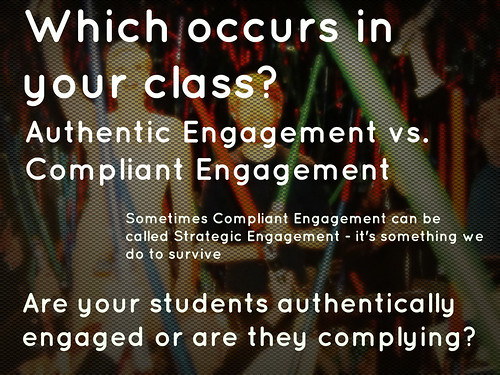
Food for Thought: Engaged or Compliant........what are your students?


Dear all,

Hope you are all having a good weekend. This morning I feel that a haze has at last been lifted from inside my head and that I am truly back in HCMC.
29460639104_a8c6e9ff11

Ken Whytock Flickr via Compfight cc

Just wanted to share this train of thought because it is useful for defining how we approach one of the three key pillars of our mission and also a section of our walk through data. The question compliant or engaged is particularly important when put into context of schools preparing students for the 21st century and their future. The work of Yong Zhao clearly identifies that one of the most important changes that has taken place in the our modern world and that education needs to address is that there is a declining demand for compliant employees as technology can easily replace these workers. What has emerged is a world where students need to be creative, innovative, flexible, problem solvers and life long learners who are prepared to be entrepreneurs and employers in the future. The importance of having engaged as part of our mission is that without this characteristic students aren't embedding their learning and understanding and able to utilize this to develop new thoughts. However, as this article from Mindshift points out there is more to being engaged that sitting in class quietly and getting on with a task. There is a lot to learn for all of us from this article, at all levels in our school about how we develop our classroom practice to further embrace our mission.


“Everything we know about the neuroscience of learning is that emotion drives cognition,” he said. But even if a student is behaving and feels good about it, if he or she isn’t actively making meaning out of the information, then active engagement still hasn’t been reached.
When Almarode visits classrooms he looks for eight different qualities that indicate students are engaged.
1. Does the activity, strategy, task, or idea allow for the student to personalize his or her response? Can they bring their life experiences into the activity and make it their own?
2. Are there clear and modeled expectations?
3. Is there a sense of audience above and beyond the teacher and the test? Does the activity have value to someone else?
4. Is there social interaction? Do students have an opportunity to talk about the learning and interact?
5. Is there a culture of emotional safety? Are mistakes valued because they are an opportunity to learn?
6. Do students have opportunities to choose within the activity?
7. Is it an authentic activity? This doesn’t mean it always must connect directly to the student’s world, but it should connect to reality.
8. Is the task new and novel? If kids are bored, it’s hard to see engagement


To complete this week's Food for Thought is a short 8 minute TED that might provoke additional thinking and links student engagement with teacher magic. When you watch it, it could easily be dismissed as irrelevant to our context as it is about urban schools in the USA. However, haven't you ever wondered why you see teachers teaching the same content, using the same pedagogy and yet the outcome for students is different. I have heard administrators in the past call this the ' je ne sais quoi' quotient that some teachers have and others do not. What makes this TED's conclusion interesting is that this teacher trainer believes that by getting to know what makes our students tick and their cultures, ie knowing who they are, then all of us can engage our students equally as well.


And finally wanted to share something different that links with our study of positive emotions and our reflection on compassion. I was reading some of the thoughts of the Dalai Lama over the vacation and came across this passage. I think it has a great deal of relevance to our thinking about how we redefine education and the school experience:

"Our modern educational system fails to provide sufficient education about compassion. The time has come to transform this whole system. Society is formed through its educational system, but the educational system does not transmit the deeper human values of compassion and kindness. Then all of society lives with this false view that leads to a superficial life, in which we live like machines that don’t need affection. We become part of that. We become like machines. That is because today’s society is based on money. A society that is based on money is aggressive, and those with power can bully and behave cruelly to others. This situation produces growing social unrest. A society that depends on money has problems that reflect its beliefs.

In reality, affection and compassion have no direct link with money. They cannot create money. Therefore, in a society in which money is the priority, people don’t take these values seriously anymore. People in positions of leadership, like politicians, have emerged from within a society that depends on money, so naturally they think like that and lead society further in that direction. In this kind of society, people who value affection and compassion are treated like fools, while those whose priority is making money become more and more arrogant."

Have a good Sunday,

Yours
Adrian

Thursday, January 5, 2017

Food For Thought: Looking forward to a great 2017 at ISHCMC

Dear all,

Hope you have all had a fantastic vacation and are ready to set ISHCMC on fire for the second half of the year. You can afford to blitz the first three weeks we are back because we have Tet looming at the end of January. 


This is a long Food for Thought, but i would really like everyone to read through the articles and watch the videos. I want our work with students on positive behaviour, language and thinking, through mindfulness and our own control of negative thinking to be an area of focus for the second half of the year. If we are going to make a difference to our students, that counters the constant bombardment of negativity that they receive from the press, media and reported news, I believe it has to be deliberate and consistent across the School. This effort cannot be haphazard or random and needs all of us to contribute and reflect upon our own modeling. If we get this right we will all feel better and ISHCMC would be an even more special place to work and learn.


The more research that appears regarding positive behavior it becomes obvious how important this is for both ourselves and our students. In this article from the Huffington post, How Complaining Rewires Your Brain For Negativity, a logical rational is created for looking on the bight side and avoiding taking the easy route of thinking negatively about events that occur in and around us each day. this article concludes by giving us strategies to find the positive in our everyday lives. As we continue to understand positive emotions it would be a good exercise to try to think positively and not complain and to try and be more grateful for what we have in our lives.

This second article from the NY Times builds on the Huffington post article and challenges us to take better control of our thoughts and stop allowing negativity to dominate how we see our daily lives and the world about us. 


Kathy Osborn

"Here’s a New Year’s challenge for the mind: Make this the year that you quiet all those negative thoughts swirling around your brain.
All humans have a tendency to be a bit more like Eeyore than Tigger, to ruminate more on bad experiences than positive ones. It’s an evolutionary adaptation that helps us avoid danger and react quickly in a crisis.
But constant negativity can also get in the way of happiness, add to our stress and worry level and ultimately damage our health. And some people are more prone to negative thinking than others. Thinking styles can be genetic or the result of childhood experiences, said Judith Beck, a psychologist and the president of the Beck Institute for Cognitive Behavior Therapy in Bala Cynwyd, Pa. Children may develop negative thinking habits if they have been teased or bullied, or experienced blatant trauma or abuse. Women, overall, are also more likely to ruminate than men, according to a 2013 study.
“We were built to overlearn from negative experiences, but under learn from positive ones,” said Rick Hanson, a psychologist and senior fellow at the Greater Good Science Center at the University of California, Berkeley."


Why for you:


Why for our students:


Wishing you all a great 2017 in which you all flourish,

Yours
Adrian

Sunday, December 11, 2016

Food for Thought: Reason why school needs to be redefined

Dear all,

As we move in to the last week before the winter break I'd like to thank you for all the hard work and effort that you have contributed towards making this another good semester for student learning, engagement and empowerment this semester. We have continued to investigate how we can redefine the school experience for our students. We started with a new 4/5 class room area which has certainly increased the possibility for collaboration and connectivity between students and teachers and provided a first insight into the new learning environments that will dominate the refurbished primary and new secondary campus in the not so distant future . Our year long inquiry into 'who we are' links perfectly with our second step on the road to becoming a Positive Education school, and is raising some interesting questions for us to solve. Gaining a deeper understanding of the 10 positive emotions has helped us look more deeply into ourselves as we search for self awareness of who we are as educators at ISHCMC. Of course there has been so much more that just these few examples but I selected these because of their focus on the individual and their contribution to the whole. I believe this is a key constituent that under pins a redefinition of education. We have to be looking at breaking the industrialized conveyor belt model of education and making it about individuals and what is best for their social, emotional and intellectual being. This includes all our stakeholders.

The readings in this week's Food for Thought are quite long and hence I am sharing them with you ahead of a vacation. I will not be writing another Food for Thought until the 8th of January.. The aim of this weeks Food for Thought is to provide further depth of understanding as to why it is time for school's to be redefined. These two article do not directly talk about education but are fundamentally linked to the need to redefine the purpose of school.
28041859501_7cfdab3553
Arizona Parrot Flickr via Compfight cc

The first is an easy to understand economics article, 'The American Dream, Quantified at Last,'  which looks at the economy of the USA and how it has changed and the impact of this on the psychology of society. It touches on Trump's electoral victory, the potential ways forward and the challenges that lay ahead. Overall it is positive but again clearly makes the point that we are living in a changing world and cannot take for granted the same economic prosperity and growth that have for the most part prevailed since the 1880's.

"For babies born in 1980 — today’s 36-year-olds — the index of the American dream has fallen to 50 percent: Only half of them make as much money as their parents did. In the industrial Midwestern states that effectively elected Donald Trump, the share was once higher than the national average. Now, it is a few percentage points lower. There, going backward is the norm.
Psychology research has shown that people’s happiness is heavily influenced by their relative station in life. And it’s hard to imagine a more salient comparison than to a person’s own parents, particularly at this time of year, when families gather for rituals that have been repeated for decades. “You’re going home for the holidays and you compare your standard of living to your parents,” Grusky, a sociologist, says. “It’s one of the few ties you have over the course of your entire life. Friends come and go. Parents are a constant.”
How, then, can the country revive Adams’s dream of a “better and richer and fuller” life for everyone? The solution has to involve some combination of faster economic growth and more widely shared growth."


15879439596_1ed11c6856
maryturck Flickr via Compfight cc

The second article, which you can listen to instead of reading by clicking on the curio button, again looks at economic change. It is an essay from AEON magazine by James Livingston, who is professor of history at Rutgers University in New Jersey. Although the title may be off putting, F..k Work, , it asks the very important question, 'what if jobs aren't the solution any more?' In the past the solution to economic woes has been a move towards full employment but is this possible today and will it solve the problems created by a changing world? What happens if life isn't about your value as a worker? So many of the parameters that western society, in particular those that are structured around the protestant work ethic, has as foundations would now need rethinking with a new rationalization to why we exist. The essay suggests that it is time to rewrite our moral and ethical thinking about work and its place in society. Of course this change links with some of the concepts that we have been developing at ISHCMC based around the need to produced employers not employees, students who are creative and can innovate, are confident in their skills, resilient to face failure and make changes, flexible as life long learner and are able to recreate themselves depending upon their environment.


"These days, everybody from Left to Right – from the economist Dean Baker to the social scientist Arthur C Brooks, from Bernie Sanders to Donald Trump – addresses this breakdown of the labour market by advocating ‘full employment’, as if having a job is self-evidently a good thing, no matter how dangerous, demanding or demeaning it is. But ‘full employment’ is not the way to restore our faith in hard work, or in playing by the rules, or in whatever else sounds good. The official unemployment rate in the United States is already below 6 per cent, which is pretty close to what economists used to call ‘full employment’, but income inequality hasn’t changed a bit. Shitty jobs for everyone won’t solve any social problems we now face.
Don’t take my word for it, look at the numbers. Already a fourth of the adults actually employed in the US are paid wages lower than would lift them above the official poverty line – and so a fifth of American children live in poverty. Almost half of employed adults in this country are eligible for food stamps (most of those who are eligible don’t apply). The market in labour has broken down, along with most others."

There is lots to be thinking about as we move towards 2017. We know that technology has transformed our world very quickly, the question is can the world now adjust and counter these changes or are we entering an era of reactionary government pretending to empathize with the masses whilst protecting the wealth of the minority.

Wishing you a peaceful and relaxing winter break.

Have a good Sunday,
Yours
Adrian

Sunday, December 4, 2016

Food for Thought: How much do we need to be happy?

Dear all,

The end of another very busy week at ISHCMC. I am sure that there will be a lot of secondary students as staff who worked on the excellent musical Honk catching up on a lot of sleep this weekend. I would just like to publicly congratulate all of you who have been involved in the recent productions, for the quality of acting and musical accompaniment  that you managed to encourage from our students and the obvious commitment and engagement that they all demonstrated through their performances.

This weeks Food for Thought is  bit a different, although it does tie very much with our mission and vision. The first part links to a website of a young (ish) man who has developed a sustainable lifestyle in California. When I trawled through his website and watched several of his videos it certainly made me reflect upon a number of things. Firstly, how happy he seemed and how this appeared contagious to those he met. Secondly, how little we really need in our lives to be happy. Thirdly, the importance of being positive and seeing good in the world rather than bad. Finally, the big question how much do we need to have a good and happy life?

This video captures many of my reflections. It is how Rob Greenfield tested out his simple theory that people are inherently good not bad.


In addition to browsing Rob Greenfield's site I would like you to take the time to read this interesting article  about how our diet impacts the environment. 


"Tell me what you eat and I will tell you what you are.” That’s what the French lawyer Jean Anthelme Brillat-Savarin, who happened to have a deep love of gastronomy, wrote in 1825. A century later, a diet-hawking American nutritionist named Victor Lindlahr rendered it as: “You are what you eat.” I propose revising it further: Tell me what you eat and I will tell you how you impact the planet.
Most of us are aware that our food choices have environmental consequences. (Who hasn’t heard about the methane back draft from cows?) But when it comes to the specifics of why our decisions matter, we’re at a loss, bombarded with confusing choices in the grocery-store aisles about what to buy if we care about planetary health. Are organic fruits and vegetables really worth the higher prices, and are they better for the environment? If I’m a meat eater, should I opt for free-range, grass-fed beef? Is it OK to buy a pineapple flown in from Costa Rica, or should I eat only locally grown apples?
The science of food’s ecological footprint can be overwhelming, yet it’s important to understand it. For starters, in wealthy societies food consumption is estimated to account for 20 to 30 percent of the total footprint of a household. Feeding ourselves dominates our landscapes, using about half the ice-free land on earth. It sends us into the oceans, where we have fished nearly 90 percent of species to the brink or beyond. It affects all the planet’s natural systems, producing more than 30 percent of global greenhouse gases. Farming uses about 70 percent of our water and pollutes rivers with fertilizer and waste that in turn create vast coastal dead zones. The food on your plate touches everything."
Have a good Sunday,
Yours
Adrian


Sunday, November 27, 2016

Food for Thought: Heads Conference reflections


Dear all,

Hope you have all had a good week, I'm sure it was busy as normal. The Cognita Head's Conference was very interesting and provided me with an excellent opportunity to meet Chris Jansen's new team and get to know them better and their ideas regarding education. I do believe that the team Chris has put together sincerely believe that the number one target for a serviced based education business is building good schools that provide a quality education for its clientele. During the conference there were keynote addresses from Sir Kevan Collins on the importance of character education; Sir Clive Woodward on how to create High Performing teams and lastly Andy Buck talked about how leadership matters in schools. All three were interesting but none were that far away from where we are, or are going at ISHCMC. 

This week's Food for Thought links directly to our classroom pedagogy and is linked to some of the ideas that the speakers above touched on in London. The first is a short video by Doug Lemov, the author of Teach Like a Champion, a book that I highly recommend that every teacher should have read and have in their pedagogical library. He believes that great teachers are not born but made, and that through careful attention to practice and pedagogical techniques it is possible for every teacher to grow. This short video, Practice makes Perfect links well to the final article for this week


This article is a summary of the findings of two researchers, John Hattie and Robert Marzano. Their work is famous and shows that there are certain characteristics that 'Great' teachers display that produce consistently high outcomes in the classroom. Although bringing the work of these two researchers together does involve nearly 100,000 school studies one still has to reflect upon the data before jumping to conclusions that it i sall correct. The article identifies the key characteristics identified by both researchers that we should all be thinking about in our classrooms. However, I do have one reservation and that is that most of the schools in the studies are not schools that are employing inquiry pedagogy to deepen student learning and understanding. Regardless an interesting read.


"John Hattie and Robert Marzano have each conducted significant reviews of what works best in the classroom.

There are some clear differences in their work.
  • They use different terminology to each other
  • Marzano uses more isolated strategies, while Hattie combines strategies into broader approaches
  • Marzano’s findings are based heavily on teacher-designed assessments, while Hattie’s findings make more use of standardized tests
However, as you can see, there is significant agreement between Robert Marzano and John Hattie when it comes to what works best in the classroom."


I will see you all late morning tomorrow.

Yours
Adrian

Saturday, November 19, 2016

Food for Thought: The Importance of Empathy in developing who we are as learners.


Dear all,

As we have been working on compassion for the past two weeks I thought that this article from Mindshift on empathy might help to build our understanding and to see the importance of empathy in our classrooms as we encourage the growth of learning skills that are applicable in the 21st century.


"Like other aspects of modern life, education can make the head hurt. So many outcomes, so much important work to do, so many solutions and strategies, so many variations on teaching, so many different kinds of students with so many different needs, so many unknowns in preparing for 21st Century life and the endless list of jobs that haven’t been invented.What if we discovered one unifying factor that brought all of this confusion under one roof and gave us a coherent sense of how to stimulate the intellect, teach children to engage in collaborative problem solving and creative challenge, and foster social-emotional balance and stability—one factor that, if we got right, would change the equation for learning in the same way that confirming the existence of a fundamental particle informs a grand theory of the universe?That factor exists: It’s called empathy."

Here is reminder of why we do Mindfulness each day. It is only a few minutes and centers around children in Australia explaining why they find mindfulness so important each day. The programme they are following is called Smiling Minds and you might find the information available on the website useful for your understanding and teaching each morning.


Have a good week,

Adrian

Sunday, November 13, 2016

Food for Thought:

Dear all,

Hope you are having a good long weekend, you all deserve a break.

Thought that I would keep this Food for Thought short and related to the big news of the week, the election of Donald Trump to the Presidency of the United States. There have been many articles written questioning how this could have happened so thought that I would share this TED interview which took place ahead of the election. You may be asking how does this link to ISHCMC and why should I care. Well, during this interview with Jonathan Haidt a leading social psychologist,' Can a divided America heal?' it becomes apparent that the characteristics portrayed in this election relate closely to normal human behavior and that with the declining influence of the 2nd WW generation we are now moving into the era of the baby boomers. Near the end of the interview Haidt refers to ways that people can address the polarization that is taking place world wide, and I think this links to our work with positive emotions and in particular empathy and compassion. When reflecting upon his arguments I felt that if the world was full of schools practicing mindfulness, positive education, and looking towards breaking the old authoritarian model of education we could avoid some of the problems that appear to be emerging on the political horizon. I hope watching this might also equip you with a few answers for when our students want to talk about the election and how Donald Trump managed to win. It might be an interesting interview to share with some of our older students in I&S or ToK or MUN club, as it does raise lots of questions about our next decade and international relations and politics.


Finally, this week also marked the passing of one of my favorite musicians/ philosophers/ social commentators, Leonard Cohen at the age of 82. I only grew to understand his work recently as I became more mature in my life and thinking. Discovering I liked Cohen's work, writings and thinking so much shows me that although we may think we know who we are at different phases of our lives we won't really know till we are nearer to its end. If you don't know much about Leonard Cohen here are two articles about him, this one from Rolling Stone is about his career, and the other from Brain Pickings is more about the predictive nature of his writing.

Have a good Sunday,

See you all on Tuesday, we will have a briefing at 7:15 in the MPR.

Yours
Adrian